
In real estate, timing rarely cooperates, notes the Renters Warehouse Milwaukee team. A buyer finds the right property, makes an offer, and then faces the uncomfortable reality that their current home has not yet sold. This is the scenario that bridge loans were designed to solve. A short-term financing instrument with a specific purpose, the bridge loan has become a strategic tool for homeowners and investors who need to move quickly in a competitive market.
Understanding what a bridge loan is — and when it makes sense to use one — can be the difference between landing a dream home and watching it go to another buyer.
What Is a Bridge Loan?
A bridge loan is a short-term real estate loan, typically lasting six to twelve months, that uses the equity in a borrower’s current home to fund the purchase of a new one before the existing property sells. It “bridges” the financial gap between two transactions, giving buyers the liquidity to act without a sale contingency.
Also referred to as a swing loan or gap financing, a bridge loan is secured by the borrower’s existing property. The loan is repaid in full once that property sells. Because of its short duration and the risk involved, bridge loans carry higher interest rates than conventional mortgages — typically ranging from 1.5% to 3% above the prime rate — and come with origination fees that can add up quickly.
Despite the cost, the appeal is straightforward: in a seller’s market where contingent offers are routinely rejected, a bridge loan allows a buyer to present a clean, non-contingent offer that competes with cash buyers.
How Does a Bridge Loan Work?
A bridge loan works by allowing a lender to advance funds — typically up to 80% of the combined value of the borrower’s current and new properties — which are then used for the down payment and closing costs on the new home. The loan is repaid when the existing home sells, usually within six to twelve months.
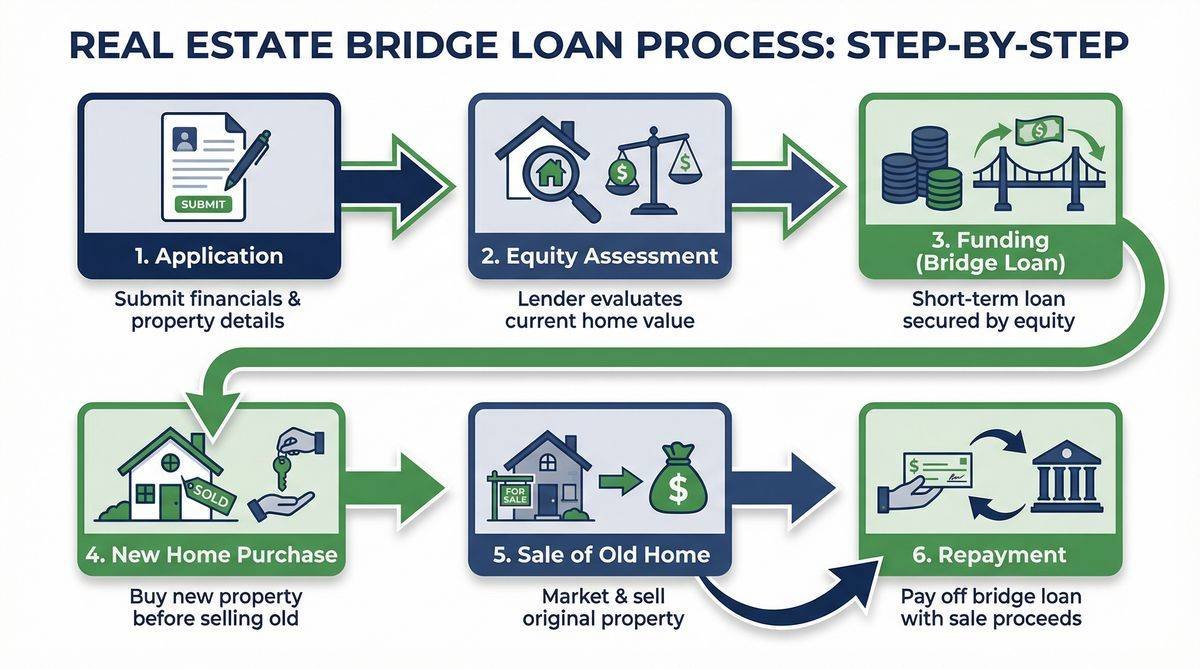
The mechanics vary slightly by lender, but the general process follows these stages:
- Application: The borrower applies with a lender, providing details on both the existing property and the target purchase.
- Equity assessment: The lender evaluates the equity in the current home, which serves as collateral. Most require at least 15% to 20% equity.
- Approval and funding: Approval can happen within days, far faster than a conventional mortgage. Funds are disbursed to cover the new purchase.
- Dual ownership period: The borrower may carry both the bridge loan and the existing mortgage simultaneously for a period.
- Repayment: Once the original home sells, the proceeds retire the bridge loan in full, including accrued interest and fees.
When to Use a Bridge Loan
Bridge loans are most appropriate when a homeowner needs to purchase a new property before their current one sells, when a competitive market demands non-contingent offers, or when an investor needs rapid short-term capital to acquire and renovate a property before securing long-term financing.
Common scenarios where bridge loans make strategic sense include:
- Buying in a seller’s market: When inventory is low and sellers favor clean offers, removing the sale contingency dramatically improves a buyer’s position.
- Avoiding temporary housing: A bridge loan allows a direct move from the old home to the new one, eliminating the cost and disruption of interim rentals.
- Investment property acquisition: Real estate investors frequently use bridge loans to acquire distressed properties, fund renovations, and then refinance or sell.
- Relocation deadlines: Job transfers or personal circumstances that require a rapid move can make bridge financing a practical necessity.
Qualifying for a Bridge Loan
To qualify for a bridge loan, lenders typically require a credit score of 700 or higher, a debt-to-income ratio below 50%, and at least 15% to 20% equity in the existing property. A credible plan for repayment — usually the pending sale of the current home — is essential.
Unlike conventional mortgages, bridge loan underwriting tends to be faster but more flexible on some criteria. The primary concern for lenders is the exit strategy: how and when will the loan be repaid? A property already listed for sale, or under contract, significantly strengthens an application. Some lenders also require the borrower to have a signed purchase agreement on their existing home before approving the bridge loan.
Pros and Cons of Bridge Loans
Bridge loans offer speed and competitive advantage in real estate transactions, but they carry higher costs and the risk of carrying two mortgage obligations simultaneously. Borrowers must weigh the strategic benefit against the financial exposure before proceeding.
| Advantages | Disadvantages |
|---|---|
| Enables purchase before existing home sells | Higher interest rates than conventional mortgages |
| Removes sale contingency from offers | Origination fees and closing costs add up |
| Fast approval — sometimes within days | Risk of carrying two mortgage payments simultaneously |
| Avoids temporary housing costs | Foreclosure risk if existing home does not sell |
| Flexible repayment structures available | Requires substantial equity in existing property |
Alternatives to Bridge Loans
Homeowners who are uncomfortable with bridge loan costs or risks have several alternatives, including home equity lines of credit (HELOCs), 80-10-10 piggyback loans, or simply selling their current home first and arranging temporary housing during the transition.
A HELOC offers a revolving credit line against existing home equity at a lower interest rate than a bridge loan, though it requires the existing home to remain unsold during the draw period. An 80-10-10 loan splits the new mortgage into two tranches to avoid private mortgage insurance and reduce the required down payment. Each alternative has trade-offs in cost, flexibility, and timing — making it essential to compare options with a mortgage professional before committing.

Frequently Asked Questions
How long does a bridge loan last?
Most bridge loans have terms of six to twelve months, though some lenders offer terms up to three years. The expectation is that the loan will be repaid as soon as the borrower’s existing property sells, well within the loan term.
What interest rates do bridge loans carry?
Bridge loan interest rates are typically 1.5% to 3% above the prime rate, making them significantly more expensive than conventional mortgages. The exact rate depends on the lender, the borrower’s credit profile, and the loan-to-value ratio of the collateral.
Can you get a bridge loan with bad credit?
It is possible but difficult. Most traditional lenders require a credit score of at least 700. Borrowers with lower scores may find options through private or hard-money lenders, but at substantially higher rates and fees.
What happens if the existing home does not sell in time?
If the property does not sell before the bridge loan matures, the borrower must either refinance the bridge loan, negotiate an extension with the lender (often at additional cost), or risk the lender initiating foreclosure proceedings on the collateral property.
What is the difference between a bridge loan and a HELOC?
A HELOC is a revolving credit line drawn against existing home equity, typically at a lower interest rate and with a longer repayment window. A bridge loan is a lump-sum, short-term instrument specifically designed to fund a new property purchase. HELOCs are generally cheaper but less flexible in competitive purchase scenarios.
Conclusion
A bridge loan in real estate is a targeted financial tool — powerful in the right circumstances, costly in the wrong ones. For homeowners navigating a competitive market who need to act decisively before their current home sells, it provides a clear strategic advantage. For those with more flexibility in timing, alternatives like HELOCs or a sell-first approach may offer a more cost-effective path. The key is understanding the mechanics, the costs, and the exit strategy before signing. When used with a clear repayment plan in place, a bridge loan can be the difference between securing the right property and missing the opportunity entirely.
- Consumer Financial Protection Bureau (CFPB). What is a bridge loan? consumerfinance.gov
- Freddie Mac. Understanding Home Equity and Loan Options. myhome.freddiemac.com
- Investopedia. Bridge Loan. investopedia.com

- I’m Aliza, the founder of Urdu Novel Bank. I built this site because I love Urdu stories and want everyone to enjoy them. As an Urdu literature lover, I choose the best novels to share with you. Here you can find free Urdu novels in romance, mystery, thriller and more. Read online or download PDF chapters without signing up. I update the library often so you’ll always have new tales to explore. My goal is to bring Urdu literature to readers around the world.