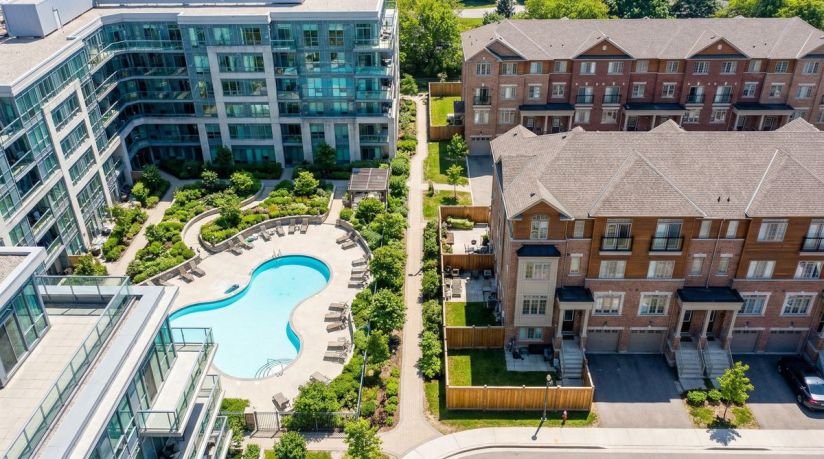
Both condominiums and townhouses occupy a popular middle ground in the housing market — more affordable than detached single-family homes, yet offering a degree of ownership that renting cannot match, notes Drexel Hill Property Management. But they are fundamentally different products, and choosing the wrong one can mean years of frustration with maintenance obligations, HOA restrictions, or a lifestyle that simply does not fit.
The distinction goes deeper than the physical structure. It touches on what you actually own, what you are responsible for, how you finance the purchase, and how the property is likely to perform as an investment. Here is a clear breakdown of the difference between a condo and a townhouse across every dimension that matters to a buyer.
Ownership Structure: The Core Difference
The fundamental difference between a condo and a townhouse is what the buyer legally owns. A condo owner holds title to the interior airspace of their unit, while the building, land, and common areas are collectively owned by all unit owners. A townhouse owner holds title to the interior, the exterior structure, and the land beneath it — a far more complete form of ownership.
This distinction has cascading implications. Because condo owners do not own the land or the building exterior, they have no individual authority over decisions affecting those elements — that power rests with the homeowners association (HOA). Townhouse owners, by contrast, own their structure and lot outright, giving them greater autonomy over exterior modifications, landscaping, and long-term use of the property.
In legal terms, a condo is classified as a form of “common interest” ownership, while a townhouse is closer to a traditional fee-simple property. This difference matters when it comes to financing, insurance, and resale.
Maintenance Responsibilities
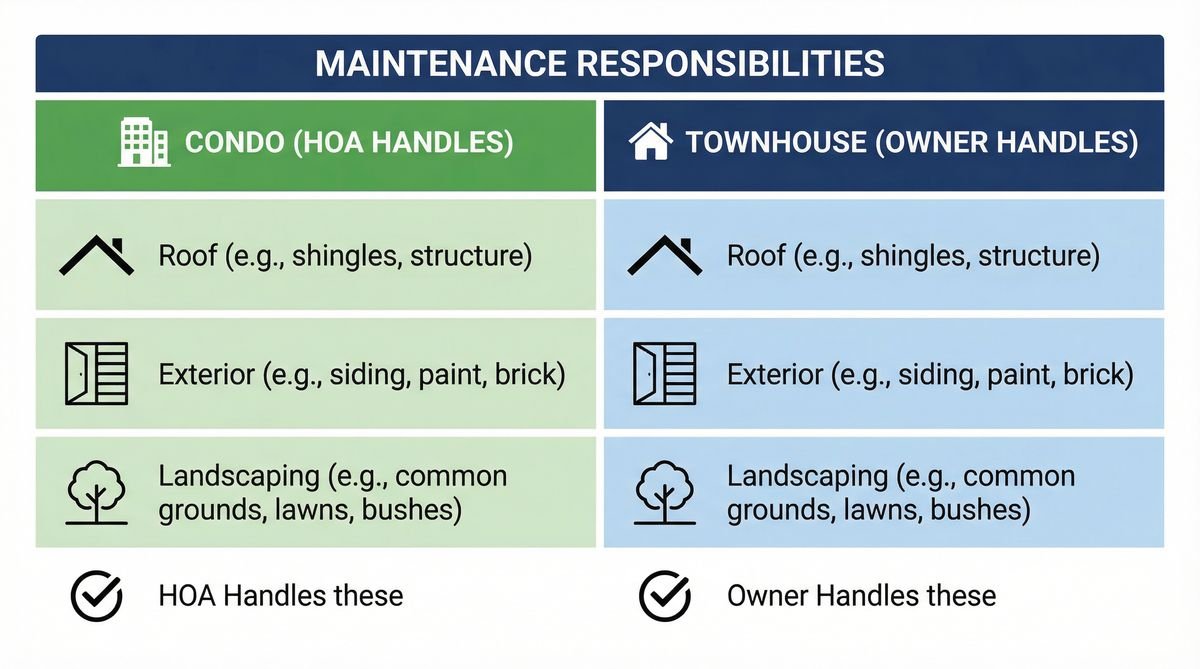
In a condominium, the HOA is responsible for all exterior maintenance — the roof, siding, landscaping, parking areas, and building systems — funded through monthly HOA fees. Townhouse owners are typically responsible for their own exterior maintenance, including the roof and yard, though some townhouse HOAs cover limited shared areas.
For buyers who travel frequently, work long hours, or simply prefer not to deal with exterior upkeep, the condo model is genuinely appealing. The trade-off is a loss of control: if the HOA is slow to address a roof issue or decides to repave the parking lot in a color you dislike, there is little recourse beyond attending HOA meetings and voting.
Townhouse ownership demands more hands-on engagement. The owner is responsible for their own roof, exterior walls, and yard. This is more work, but it also means decisions are made on the owner’s timeline and to the owner’s standards.
HOA Fees and Rules
Condo HOA fees are generally higher than townhouse HOA fees because they cover a broader scope of services, including exterior building maintenance, building insurance, and shared amenities. Townhouse HOA fees, where they exist, typically cover only shared common areas and community landscaping.
The range is wide. Condo HOA fees in urban markets can run from $300 to over $1,000 per month, depending on the building’s amenities and age. Townhouse HOA fees are more commonly in the $100 to $400 range. However, the fee alone does not tell the full story — what matters is what the fee covers and the financial health of the association’s reserve fund.
Both condo and townhouse HOAs impose rules that govern how owners use their properties. These can include restrictions on pets, rental activity, exterior modifications, parking, and noise. Reviewing the HOA’s CC&Rs (Covenants, Conditions, and Restrictions) before purchase is essential, as violations can result in fines and legal disputes.
Financing Differences
Financing a condo is more complex than financing a townhouse. Lenders scrutinize the HOA’s financial health, the percentage of owner-occupied units, and whether the building meets agency guidelines before approving a conventional or FHA loan. Townhouses are financed much like single-family homes, with fewer lender-imposed restrictions.
For a condo to be eligible for conventional financing backed by Fannie Mae or Freddie Mac, the project must meet specific criteria — including a minimum owner-occupancy rate (typically 50% or higher) and adequate HOA reserves. Buildings that fail these tests may only be eligible for portfolio loans at higher rates, or may require a larger down payment. This can limit the buyer pool and affect resale.
Townhouses, because they include land ownership and are structured more like single-family homes, face far fewer lender restrictions. This generally makes them easier to finance and easier to sell to a broad range of future buyers.
Investment and Resale Value
Townhouses tend to appreciate more consistently over time because they include land ownership, which is the primary driver of long-term real estate value. Condo appreciation is more variable and closely tied to the building’s condition, HOA management quality, and the strength of the local condo market.
This does not mean condos are poor investments — in high-demand urban markets, well-located condos can appreciate significantly. But the land component of townhouse ownership provides a floor of value that condos lack. A deteriorating condo building with a financially troubled HOA can see values stagnate or decline even in a strong overall market, while a townhouse owner retains control over their own property’s condition.

Quick Comparison: Condo vs. Townhouse
| Feature | Condominium | Townhouse |
|---|---|---|
| What you own | Interior airspace only | Interior, exterior structure, and land |
| Exterior maintenance | HOA responsibility | Owner responsibility (usually) |
| HOA fees | Higher (broader coverage) | Lower (limited coverage) |
| Private outdoor space | Rare; usually shared | Common (yard, patio, or garage) |
| Financing complexity | Higher (project approval required) | Lower (treated like single-family) |
| Appreciation pattern | Variable; building-dependent | More consistent; land-driven |
| Best for | Low-maintenance, urban lifestyle | More space, privacy, and control |
Frequently Asked Questions
Which is cheaper to buy — a condo or a townhouse?
Condos are generally less expensive to purchase than townhouses in the same area, making them a more accessible entry point into homeownership. However, higher monthly HOA fees can offset the lower purchase price over time, so the total cost of ownership should be compared rather than the purchase price alone.
Is a condo or townhouse a better investment?
Townhouses tend to appreciate more reliably over time because they include land ownership, which is the primary driver of long-term real estate value. Condos can be strong investments in high-demand urban markets, but their appreciation is more closely tied to the building’s condition and HOA management quality.
Which offers more privacy?
Townhouses generally offer more privacy than condos. While both share walls with neighbors, townhouses typically have fewer shared walls (one or two sides), private entrances, and individual outdoor spaces. Condos in multi-story buildings share floors and ceilings with neighbors in addition to walls, which can increase noise and reduce the sense of separation.
Can I renovate or customize a condo or townhouse?
Townhouse owners have significantly more freedom to renovate, as they own the entire structure and land. Condo owners are generally restricted to interior modifications within their unit and must obtain HOA approval for any changes that affect shared systems or structural elements. Exterior modifications are almost always prohibited in condos.
Do all condos and townhouses have HOAs?
Most do, but not all. Some townhouse communities are sold without HOA governance, giving owners full autonomy over their property. Condos almost universally require an HOA because the shared ownership of the building structure and common areas necessitates a governing body to manage maintenance and finances.
Conclusion
The difference between a condo and a townhouse is not simply a matter of layout — it is a question of ownership, responsibility, and lifestyle. Condos offer a lower-maintenance, amenity-rich living experience at a typically lower purchase price, but with higher ongoing fees and less individual control. Townhouses provide a more complete form of ownership, greater privacy, and stronger long-term appreciation potential, but require more active involvement in property maintenance.
Neither is universally superior. The right choice depends on how a buyer plans to live in the property, how much maintenance responsibility they are willing to accept, and what their long-term financial goals look like. Understanding these differences clearly before signing a purchase agreement is the most important step any buyer can take.
- Fannie Mae. Condo, Co-op, and PUD Project Eligibility. fanniemae.com
- Consumer Financial Protection Bureau (CFPB). What is a homeowners association (HOA)? consumerfinance.gov
- National Association of Realtors (NAR). Homeownership and Property Rights. nar.realtor

- I’m Aliza, the founder of Urdu Novel Bank. I built this site because I love Urdu stories and want everyone to enjoy them. As an Urdu literature lover, I choose the best novels to share with you. Here you can find free Urdu novels in romance, mystery, thriller and more. Read online or download PDF chapters without signing up. I update the library often so you’ll always have new tales to explore. My goal is to bring Urdu literature to readers around the world.