The Vegetarian: A Story of Quiet Rebellion
Han Kang’s “The Vegetarian” is not a book about food. It is a story about a woman who decides to stop eating meat, and in doing so, unravels her life and the lives of those around her. This haunting novel, which won the Man Booker International Prize in 2016, is a profound exploration of conformity, violence, and the silent scream of a woman desperate to break free. It’s a book that gets under your skin and stays there.
Yeong-hye, the protagonist, is an ordinary woman living an unremarkable life. Her husband describes her as “completely unremarkable in any way.” But one day, a series of violent, bloody nightmares leads her to a simple, yet radical decision: she will no longer eat meat. This choice, a quiet act of personal conviction, becomes an act of rebellion against a world that seeks to control her. It’s a small act that will have devastating consequences.
A Disturbing Dream and a Drastic Decision
The story begins with this seemingly small act of defiance. Yeong-hye’s decision is not a lifestyle choice; it is a visceral reaction to the brutality she witnesses in her dreams. She is not trying to be healthy or trendy. She is trying to purge herself of the violence that permeates her world, a violence she feels is inherent in the consumption of flesh. It’s a rejection of the very nature of being human, as she sees it.
Her husband is bewildered and annoyed. Her family is scandalized. They cannot understand why she would make such a strange and inconvenient choice. Her refusal to conform is seen as an affront to their way of life, a disruption to the patriarchal order that governs their existence. In their eyes, she is not just a vegetarian; she is a traitor.
The Family as a Cage
The family’s reaction quickly escalates from confusion to coercion. At a family dinner, her father, a man known for his violent temper, tries to force a piece of pork into her mouth. When she resists, he slaps her. Her husband and brother hold her down as her father shoves the meat into her mouth. This brutal act of violation is a turning point in the novel. It’s a scene that is both shocking and unforgettable.
In a desperate act of self-preservation, Yeong-hye spits out the meat, grabs a fruit knife, and slits her wrist. This is not a suicide attempt; it is a declaration of war. It is a statement that she would rather die than be force-fed violence. From this moment on, her body becomes a battlefield, the last territory she can claim as her own. It’s a horrifying and powerful image.
A Woman’s Body, A Man’s Canvas
As Yeong-hye retreats further into herself, she becomes an object of fascination for her brother-in-law, a video artist. He becomes obsessed with her Mongolian spot, a birthmark on her buttock, and sees her as a canvas for his art. He persuades her to pose for him, painting flowers on her naked body, and eventually films a sexually explicit video with her. He is drawn to her brokenness, her vulnerability.
His artistic vision is just another form of objectification. He does not see her as a person; he sees her as a beautiful, broken thing to be captured and displayed. He is no different from her husband or her father, who also see her as a possession to be controlled and used for their own purposes. He is another man who wants to own her, to possess her.
The Transformation into a Tree
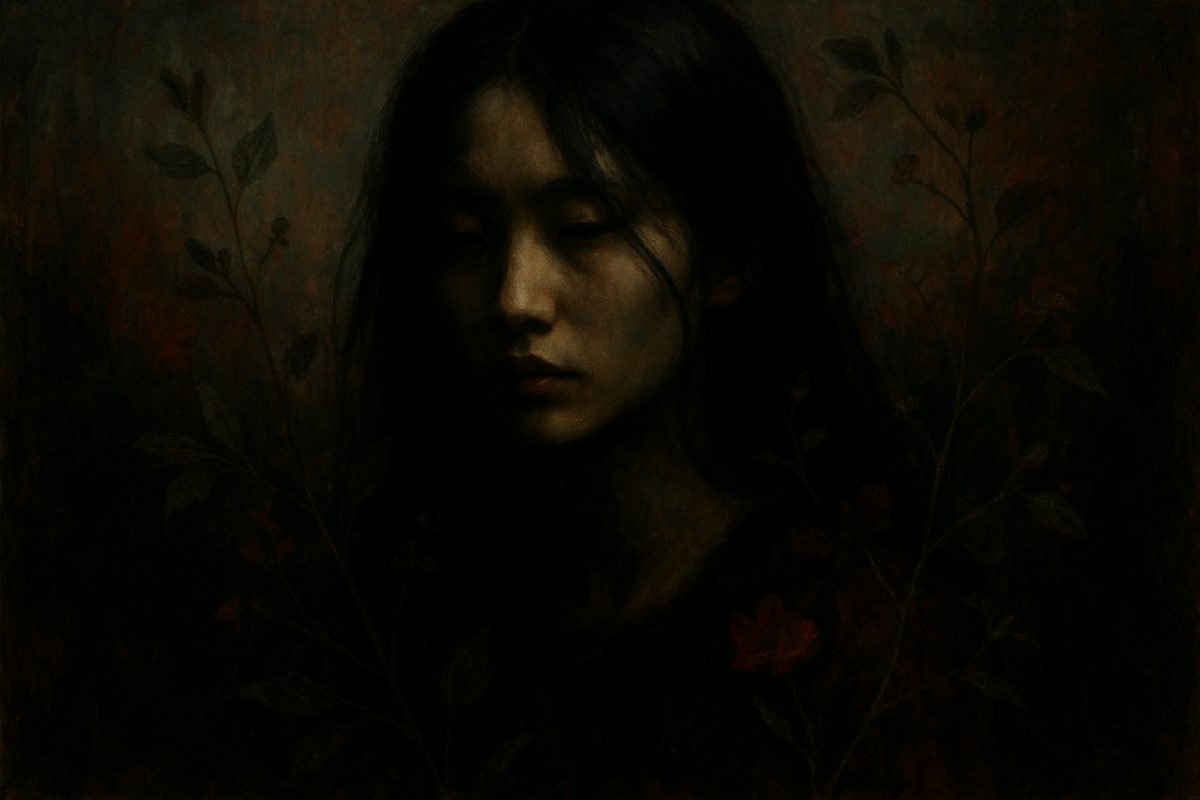
In the final part of the novel, Yeong-hye is in a mental hospital, diagnosed with anorexia and schizophrenia. She has stopped eating altogether, believing she is becoming a tree. She stands on her hands, hoping to grow roots. She basks in the sun, trying to photosynthesize. She is shedding her humanity, which she has come to associate with violence and suffering. It’s a strange and beautiful and tragic transformation.
Her transformation into a tree is a powerful metaphor for her desire to escape the human world. Trees are silent, passive, and non-violent. They are rooted in the earth, drawing sustenance from the sun and the rain. For Yeong-hye, becoming a tree is the ultimate act of rebellion, a way to achieve a state of pure, unadulterated being. It’s a desperate attempt to find peace in a world that has only shown her violence.
The Sister’s Awakening
The final section is told from the perspective of Yeong-hye’s sister, In-hye. She is the only one who continues to care for Yeong-hye, and in doing so, she begins to question her own life. She realizes that she, too, is trapped in a cage, a cage of societal expectations and domestic responsibilities. She has followed all the rules, and yet she is just as unhappy as her sister.
In-hye sees that her sister’s “madness” is a form of freedom, a refusal to endure the quiet desperation that has defined her own life. She begins to understand that Yeong-hye’s rebellion is not just against meat, but against a world that denies women their autonomy and their voice. It’s a realization that is both liberating and terrifying.
A Mirror to Society
“The Vegetarian” is a searing critique of South Korean society, but its themes are universal. It is a story about the violence that is inflicted on women’s bodies and minds, the pressure to conform, and the courage it takes to say “no.” It is a novel that will haunt you long after you have finished reading it. It’s a book that will make you think, and feel, and maybe even scream.
The book’s power lies in its refusal to provide easy answers. We never fully understand Yeong-hye’s motivations, and her voice is largely absent from the narrative. We see her only through the eyes of others, who project their own desires and fears onto her. This narrative choice brilliantly underscores the novel’s central theme: the silencing and objectification of women. We are forced to confront our own biases and assumptions, to question what we think we know about sanity and madness.
The Legacy of The Vegetarian
“The Vegetarian” is a novel that is both beautiful and brutal, a story that is as disturbing as it is profound. It is a book that will make you question your own assumptions about sanity, conformity, and the nature of humanity itself. It’s a book that will stay with you, long after you’ve turned the final page.
Han Kang has written a masterpiece, a novel that will be read and discussed for years to come. It is a silent scream that echoes in the reader’s mind, a testament to the enduring power of the human spirit to resist, even in the face of overwhelming despair. It’s a book that demands to be read.

- I’m Aliza, the founder of Urdu Novel Bank. I built this site because I love Urdu stories and want everyone to enjoy them. As an Urdu literature lover, I choose the best novels to share with you. Here you can find free Urdu novels in romance, mystery, thriller and more. Read online or download PDF chapters without signing up. I update the library often so you’ll always have new tales to explore. My goal is to bring Urdu literature to readers around the world.
Latest Novels
- July 29, 2026Home ImprovementCabinet Painting Cost Per Linear Foot: Complete Pricing Guide for Kitchens
- May 4, 2026Urdu Romantic NovelsHow Incorporating Moroccan Tile Enhances Your Home Décor
- April 29, 2026Home ImprovementHow Finding a Reliable Plumber Near Me Transforms Plumbing Emergencies
- April 27, 2026Home ImprovementHow to Plan a Layered Lighting Scheme for Your Bedroom Renovation