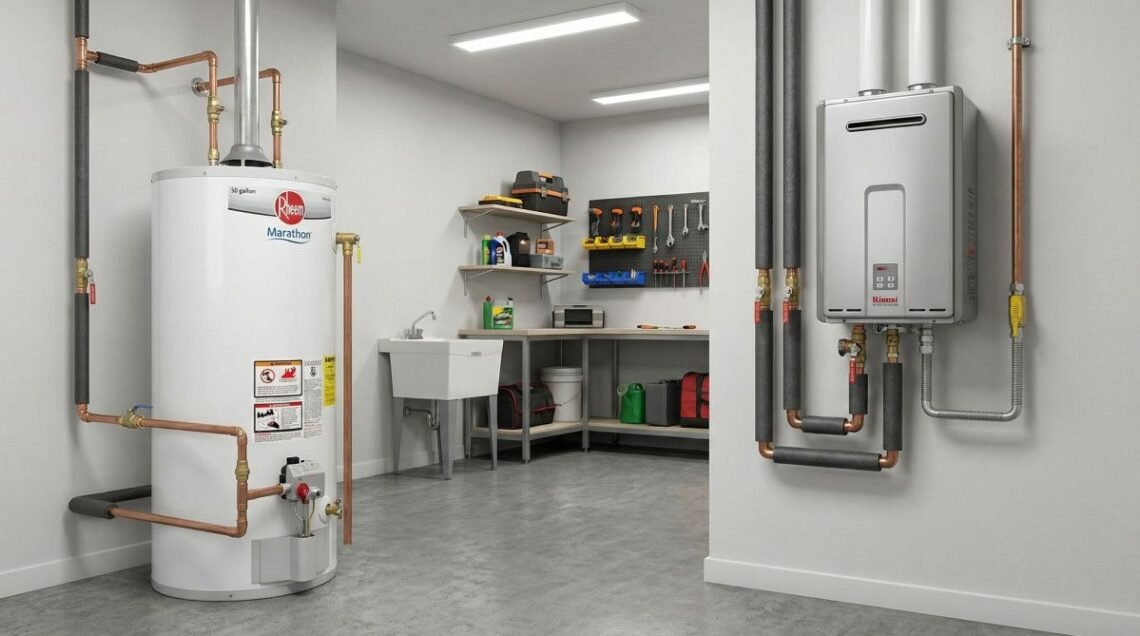
A tankless water heater typically saves more money over its lifetime than a traditional tank model due to higher energy efficiency and a significantly longer operational lifespan. While the initial purchase and installation costs for tankless systems are higher, homeowners can expect to save approximately $95 annually on energy bills and avoid the cost of a replacement unit for over two decades. Over the course of 20 years, the total savings from reduced energy consumption and fewer equipment replacements often exceed $1,800.
Understanding the Initial Investment Costs
The primary barrier to choosing a tankless water heater is the upfront cost, which is substantially higher than that of a storage tank unit. A standard tank water heater typically costs between $600 and $2,500 for both the unit and professional installation. These systems are relatively simple to install because they use existing plumbing and venting configurations in most homes.
In contrast, a tankless water heater generally requires an investment of $1,400 to $3,900 or more. The higher price tag is not just for the technology itself but also for the complex installation requirements. Many homes need upgrades to gas lines to handle the high BTU demand of tankless units, specialized stainless steel venting to manage acidic exhaust, or electrical panel upgrades for high-voltage electric models. While these costs are significant, they represent a one-time investment in a system designed to last twice as long as a traditional tank.
Energy Efficiency and Monthly Utility Savings
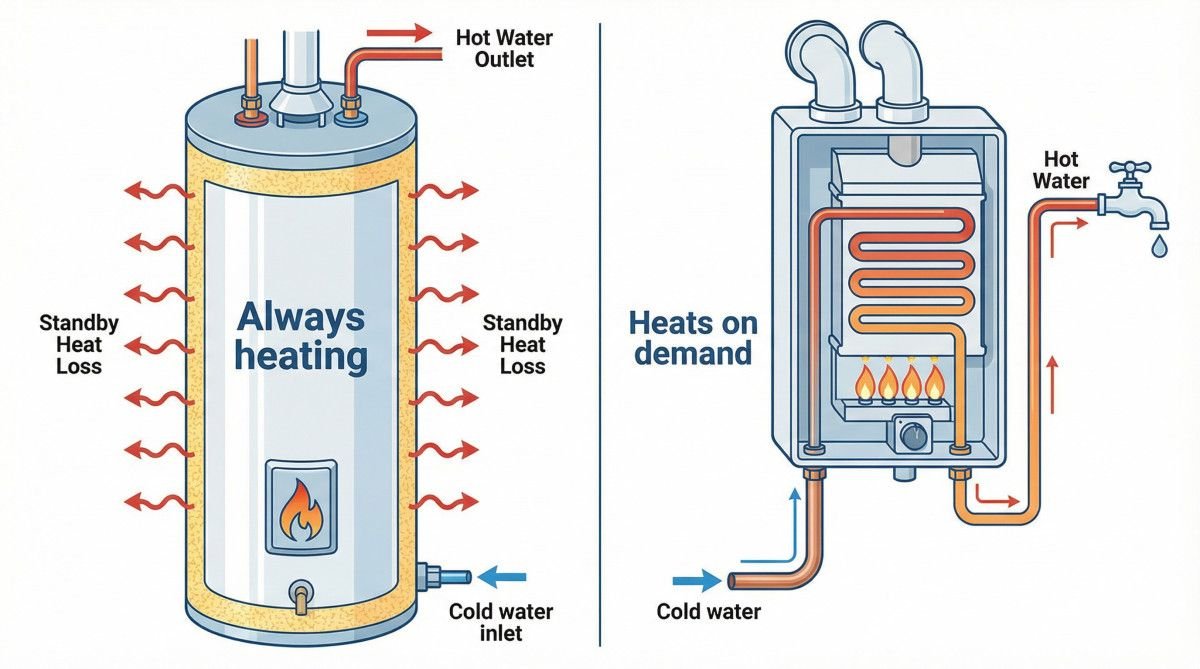
Tankless water heaters save money primarily by eliminating standby heat loss. Traditional tanks must constantly heat and reheat 40 to 80 gallons of water to maintain a set temperature, even when no one is home. This process consumes energy 24 hours a day. Tankless units, however, only activate when a hot water faucet is turned on, heating the water instantaneously as it flows through the heat exchanger.
According to the U.S. Department of Energy, tankless water heaters can be 24% to 34% more energy efficient than conventional storage tank water heaters for homes that use 41 gallons or less of hot water daily. Even in high-use households consuming around 86 gallons per day, tankless systems remain 8% to 14% more efficient. These efficiency gains translate directly into lower monthly utility bills, with Energy Star certified gas models saving a typical family of four nearly $100 every year.
Long-Term Value and Equipment Lifespan
When calculating which system saves more money, the lifespan of the equipment is a critical factor. A traditional storage tank water heater has an average life expectancy of 10 to 15 years. The constant presence of water inside the steel tank eventually leads to corrosion and sediment buildup, which can cause the tank to leak or fail entirely. Once a tank begins to leak, the entire unit must be replaced.
Tankless water heaters are built with more durable components and are designed to last 20 years or more. Because they do not store water, they are less prone to the catastrophic tank failures that often cause expensive water damage in homes. Furthermore, tankless units are designed with modular parts that can be easily replaced if they fail, potentially extending the unit’s life even further. By choosing a tankless system, a homeowner avoids the cost of purchasing and installing a second tank unit midway through the tankless system’s life.
Comparing Total Cost of Ownership
To determine the true financial impact, it is helpful to look at the total cost of ownership over a 20-year period. This includes the purchase price, installation, energy costs, and maintenance requirements for both types of systems. While the tankless system has a higher starting point, its lower operating costs and lack of a mid-cycle replacement make it the more economical choice for long-term residents.
| Feature | Storage Tank Water Heater | Tankless Water Heater |
|---|---|---|
| Average Upfront Cost | $600 – $2,500 | $1,400 – $3,900+ |
| Expected Lifespan | 10 – 15 Years | 20+ Years |
| Annual Energy Savings | Baseline | $95 – $100+ |
| 20-Year Replacement Cost | $1,200 – $5,000 (2 units) | $1,400 – $3,900 (1 unit) |
| Energy Efficiency | 60% – 70% | 80% – 99% |
| Total 20-Year Savings | $0 | $1,800+ |
Maintenance Requirements and Operational Costs
Maintenance is an often-overlooked aspect of the cost comparison. Both systems require periodic attention to remain efficient. Traditional tanks should be flushed every one to three years to remove sediment that settles at the bottom, which can reduce heating efficiency and damage the tank. This is a relatively simple task that many homeowners perform themselves.
Tankless water heaters require more specialized maintenance, specifically an annual descaling or flushing process. This is especially important in areas with hard water, as mineral scale can build up on the heat exchanger and reduce efficiency or cause the unit to overheat. While a professional descaling service may cost between $150 and $200, this investment ensures the unit reaches its full 20-year lifespan and maintains its high energy efficiency ratings. Neglecting this maintenance can lead to premature failure and void the manufacturer’s warranty.
Factors That Influence Your Potential Savings
The actual amount of money saved by switching to a tankless water heater depends on several household-specific factors. Fuel type is one of the most significant variables; gas-fired tankless units generally offer higher flow rates and better energy savings than electric models. Additionally, the local cost of natural gas versus electricity will impact the monthly savings seen on utility bills.
Household water usage patterns also play a role. Families that use a large volume of hot water simultaneously—such as running a dishwasher, washing machine, and shower at the same time—may find that a single tankless unit cannot keep up with the demand. In these cases, installing multiple units or a larger, more expensive model may be necessary, which increases the initial investment and extends the payback period. However, for most average households, the transition to tankless technology provides a clear financial advantage over the long term.
Does a tankless water heater really save money?
Yes, a tankless water heater saves money over the long term by reducing energy consumption by up to 34% and lasting twice as long as a traditional tank. Most homeowners see a total lifetime saving of approximately $1,800 when considering both energy bills and equipment replacement costs.
How long does it take for a tankless water heater to pay for itself?
The payback period for a tankless water heater typically ranges from 10 to 20 years. This duration depends on the initial installation complexity, local energy rates, and the amount of hot water the household consumes daily.
Are tankless water heaters more expensive to maintain?
Tankless units require an annual descaling to remove mineral buildup, which can be more expensive than the simple flushing required for tank models. However, this maintenance is essential for preserving the unit’s high efficiency and ensuring it lasts for its full 20-year life expectancy.
Can a tankless water heater increase the value of a home?
Many homebuyers view tankless water heaters as a premium upgrade due to their energy efficiency and space-saving design. While it may not dollar-for-dollar increase the asking price, it can make a home more attractive to environmentally conscious and budget-minded buyers.
Is it worth switching from a tank to a tankless system?
Switching is most beneficial for homeowners who plan to stay in their current residence for at least 10 years. The long-term energy savings and the avoidance of a mid-cycle tank replacement provide the best return on investment over a decade or more of use.
Do tankless water heaters work during a power outage?
Most modern tankless water heaters, including gas models, require electricity to operate the electronic ignition and control panel. Unless the unit is connected to a backup generator or battery system, it will not provide hot water during a power outage, unlike some older gas tanks with standing pilot lights.

- I’m Aliza, the founder of Urdu Novel Bank. I built this site because I love Urdu stories and want everyone to enjoy them. As an Urdu literature lover, I choose the best novels to share with you. Here you can find free Urdu novels in romance, mystery, thriller and more. Read online or download PDF chapters without signing up. I update the library often so you’ll always have new tales to explore. My goal is to bring Urdu literature to readers around the world.
Latest Novels
- April 10, 2026Fashion & BeautyBeauty Shortcuts That Actually Deliver Lasting Results
- April 8, 2026AutoUpgrading Your 4WD for the Ultimate Off-Road Touring Lifestyle
- April 6, 2026Home ImprovementHow to stop drafts coming through windows
- April 5, 2026Home ImprovementWallpaper vs Paint Which Is Better for Living Room