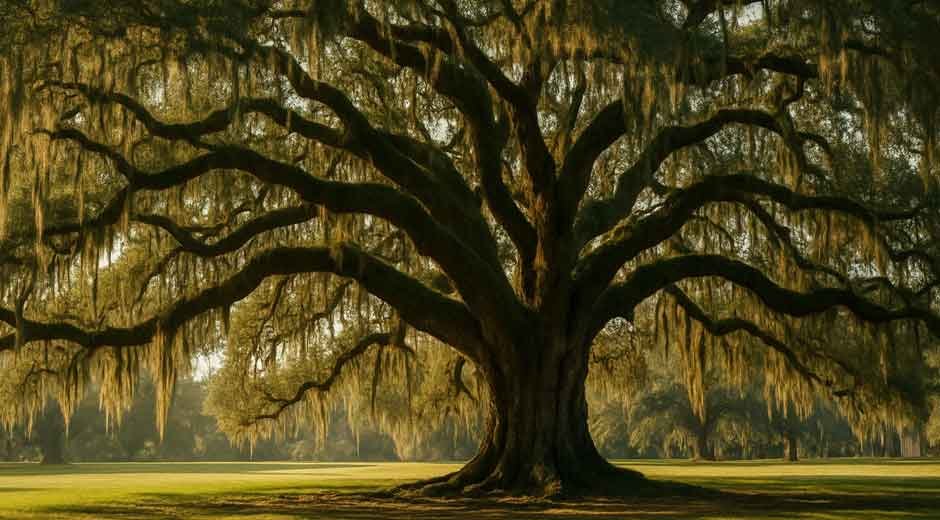
The Southern Live Oak (Quercus virginiana) is more than just a tree; it is a living monument, an enduring symbol of the American South. With its massive, sprawling canopy and gnarled, moss-draped limbs, this majestic species embodies a unique blend of resilience, history, and natural beauty. It is a defining feature of the coastal plains, its presence deeply woven into the ecological and cultural fabric of the region.
A Portrait of Resilience: Physical Characteristics
The Southern Live Oak is instantly recognizable by its distinctive growth habit. Unlike many of its deciduous relatives, the live oak is semi-evergreen, retaining its leaves until new foliage emerges in the spring. This characteristic gives it the “live” designation, ensuring its canopy remains lush and green throughout the year.
The tree rarely exceeds 50 to 80 feet in height, but its true grandeur lies in its immense width. Mature specimens can boast a crown spread of up to 100 feet or more, creating a vast, cooling expanse of shade. The branches are famously sinuous, often plunging toward the ground before curving back up, a growth pattern that contributes to its picturesque, storybook appearance.
The leaves are small, leathery, and dark green, with smooth or slightly spiny margins. The bark on young trees is a reddish-brown with furrows, which matures into a thick, black, and blocky texture that offers protection. The tree produces small, sweet acorns, which serve as a vital food source for a variety of wildlife in the autumn.
An Ecological Cornerstone of the Coastal Landscape
Native to the coastal plains from Virginia down to Florida and west to Texas, the Southern Live Oak is a keystone species of the maritime forest ecosystem. Its deep, extensive root system and dense wood are perfectly adapted to the challenging conditions of the coastal environment.
The tree exhibits a remarkable tolerance for salt spray and sandy, often poor, soils. This resilience makes it an essential natural defense against the elements. Its low, broad structure and sturdy branches allow it to withstand the high winds of tropical storms and hurricanes, earning it the local moniker of a “storm tree.”
The sprawling canopy provides crucial habitat and shelter for countless species. The acorns are a staple for deer, squirrels, and various birds, including wild turkeys and mallards. Furthermore, the tree supports a wide array of insects, including the larvae of numerous butterfly and moth species, making it a critical link in the local food web.
Woven into the Tapestry of American History
The strength and durability of the live oak have been recognized for centuries. In pre-Columbian America, Native peoples utilized the tree’s acorns for food. Later, in the late 18th century, the United States Navy prized the naturally curved and incredibly tough live oak timber for shipbuilding.
The most famous example of this historical use is the USS Constitution, launched in 1797. Her hull, partially constructed from live oak, was so resilient that cannonballs reportedly bounced off it during the War of 1812, earning the ship the legendary nickname “Old Ironsides.” This historical connection cemented the tree’s status as a symbol of American fortitude.
Today, ancient live oaks like the Angel Oak in South Carolina, estimated to be hundreds of years old, draw visitors from around the world. These titans are protected and celebrated, serving as tangible links to the past and inspiring awe with their sheer longevity and size.
Cultivation and Care for a Timeless Shade Tree
Due to its impressive size and longevity, the Southern Live Oak is a magnificent choice for large landscapes and public spaces, providing unparalleled shade. It thrives best in full sun to partial shade and is adaptable to a range of well-drained, acidic to neutral soils, including clay and sand.
While the tree is fast-growing in its youth, its growth rate slows as it matures, allowing it to reach its maximum trunk diameter over many decades. Its natural wind resistance makes it a low-maintenance choice once established. However, proper pruning is essential in its early years to ensure a strong structure that can support the massive weight of its mature limbs.
The Southern Live Oak stands as a powerful testament to nature’s ability to endure. From its role in maritime history to its vital ecological function and its commanding presence in the modern landscape, this magnificent tree continues to inspire and shelter all who live beneath its sweeping, timeless canopy.
SEO Optimization and Readability
To ensure the article is easily discoverable and engaging, the content has been structured with both search engines and human readers in mind. The primary keyword, Southern Live Oak, is naturally integrated into the title, headings, and body text. Secondary keywords like Quercus virginiana, maritime forest, Old Ironsides, and shade tree are also included to capture a broader range of search queries.
The text is formatted to enhance readability, with short paragraphs of two to three lines each, preventing large blocks of text that can overwhelm a reader. The tone is descriptive and authoritative, written from a third-person perspective to maintain a professional yet engaging voice, minimizing “AI-flavor” by focusing on evocative language and historical context. The use of H2 headings clearly segments the content, making it easy for both readers and search engines to understand the article’s structure and key topics.

- I’m Aliza, the founder of Urdu Novel Bank. I built this site because I love Urdu stories and want everyone to enjoy them. As an Urdu literature lover, I choose the best novels to share with you. Here you can find free Urdu novels in romance, mystery, thriller and more. Read online or download PDF chapters without signing up. I update the library often so you’ll always have new tales to explore. My goal is to bring Urdu literature to readers around the world.