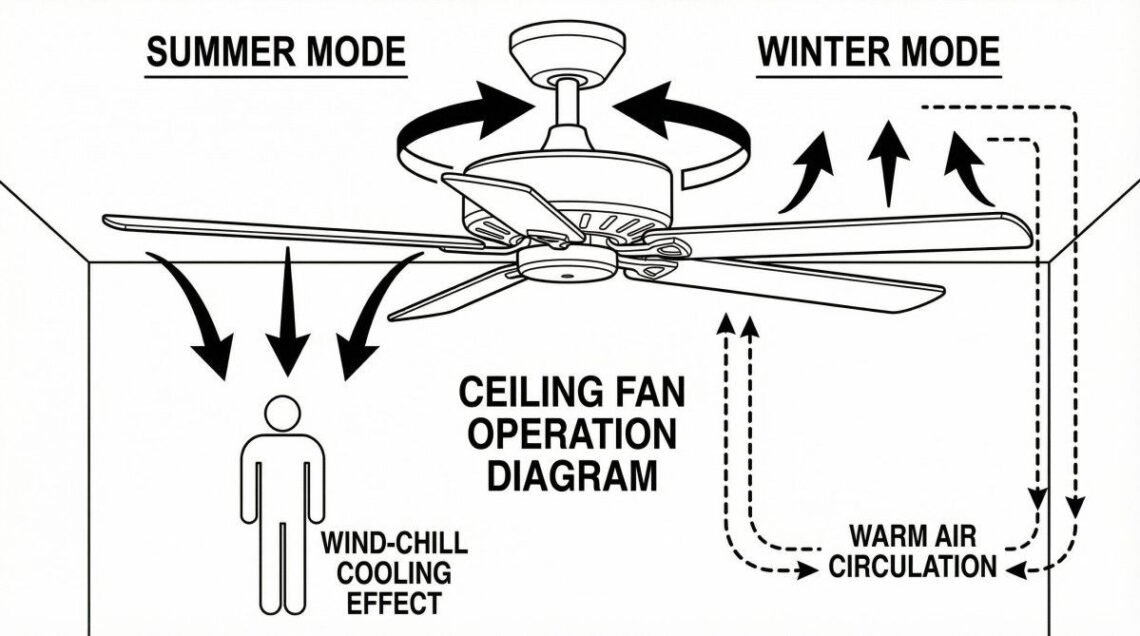
Yes, ceiling fan direction matters significantly because it determines whether the unit creates a cooling downdraft or a warming updraft. In the summer, a counterclockwise rotation produces a direct breeze that cools occupants through the wind chill effect, while a clockwise rotation in the winter recirculates trapped heat from the ceiling back down into the living space. Adjusting this setting according to the season allows homeowners to maintain comfort while reducing the load on their HVAC systems, says Compass Property Management solutions.
The science of seasonal airflow and the wind chill effect
The primary reason ceiling fan direction matters is the physics of airflow and its interaction with human skin. During the warmer months, the fan should be set to rotate counterclockwise at a high speed. This specific orientation pushes air directly downward in a column, creating what is known as a downdraft. While the fan does not actually lower the temperature of the room, the moving air speeds up the evaporation of moisture on the skin, which carries away body heat and makes the occupants feel significantly cooler.
Conversely, in the winter, the goal shifts from cooling people to moving air that has already been heated. Because warm air is less dense than cool air, it naturally rises and becomes trapped near the ceiling, a phenomenon known as stratification. By reversing the fan to a clockwise direction and running it at a low speed, the blades pull cool air upward. This upward movement displaces the warm air at the ceiling, forcing it out toward the walls and back down into the room without creating a strong, chilling breeze.
Optimizing fan settings for summer cooling
To maximize the benefits of a ceiling fan during the summer, the blades must be positioned to “slice” into the air and push it down. Most modern fans are designed so that a counterclockwise rotation achieves this effect. When standing directly under the fan, you should be able to feel a distinct breeze immediately. If you do not feel the air moving downward, the fan is likely spinning in the wrong direction or is set to a speed that is too low for the room’s dimensions.
The Department of Energy notes that using a ceiling fan effectively can allow homeowners to raise their air conditioning thermostat by approximately 4 degrees Fahrenheit without any loss in perceived comfort [1]. This adjustment can lead to substantial energy savings over the course of a cooling season. However, it is important to remember that fans cool people, not rooms. Because the cooling effect relies on the wind chill factor, leaving a fan running in an empty room provides no benefit and simply wastes electricity.
Maximizing heating efficiency in the winter
During the winter months, the objective is to reclaim the heat that is otherwise wasted at the top of the room. Switching the fan to a clockwise rotation at a low speed creates a gentle updraft. This subtle movement is enough to break up the layers of warm air near the ceiling and mix them with the cooler air below. This process, often called destratification, ensures that the heat produced by a furnace or heat pump is distributed more evenly throughout the living area.
Using a ceiling fan in the winter can reduce heating costs by as much as 10 to 15 percent by allowing the thermostat to be set lower while maintaining the same level of warmth at floor level. The low-speed setting is crucial during this season; if the fan spins too quickly, it may create a draft that makes the room feel colder, defeating the purpose of the adjustment. Homeowners with vaulted or high ceilings stand to benefit the most from this practice, as these spaces often have the greatest temperature differences between the floor and the ceiling.
Comparing summer and winter ceiling fan configurations
Understanding the specific differences between seasonal settings is essential for maintaining an energy-efficient home. The following table summarizes the key configurations and their intended effects on the indoor environment.
| Feature | Summer Configuration | Winter Configuration |
|---|---|---|
| Rotation Direction | Counterclockwise | Clockwise |
| Airflow Pattern | Downdraft (Direct) | Updraft (Indirect) |
| Recommended Speed | High or Medium | Low |
| Primary Benefit | Wind chill cooling effect | Heat recirculation |
| Thermostat Impact | Raise by 4 degrees | Lower by 2-3 degrees |
How to verify and change your fan direction
Verifying the direction of a ceiling fan is a straightforward process that should be performed at the start of every season. To check the rotation, turn the fan on and stand directly beneath the blades. In the summer, you should feel a cool breeze immediately. If you are unsure, turn the fan off and watch the blades as they slow down; they should be moving from right to left (counterclockwise). For winter, the blades should move from left to right (clockwise), and you should not feel a direct breeze while standing underneath.
Most ceiling fans feature a small toggle switch on the motor housing, just above the blades, to reverse the direction. On newer models, this function may be integrated into a remote control or a wall switch. If the fan is controlled by a smart home system, the direction can often be adjusted through a mobile application. It is best practice to clean the fan blades before reversing the direction, as the change in airflow can dislodge accumulated dust and distribute it throughout the room.
Special considerations for different ceiling types
While the general rules for fan direction apply to most standard rooms, certain architectural features require specific adjustments. For instance, in rooms with very high or vaulted ceilings, the winter setting is particularly effective at moving large volumes of trapped air. In these cases, the fan may need to run at a slightly higher speed than the standard “low” setting to ensure the warm air reaches the floor, provided it does not create a noticeable draft.
Outdoor ceiling fans on porches or patios should almost always be set to the summer (counterclockwise) direction. Since these areas are not climate-controlled, the goal is purely to provide a cooling breeze for people sitting outside. Additionally, the strong downdraft created by a counterclockwise rotation can help deter flying insects, such as mosquitoes, which are weak fliers and struggle to navigate through the moving air. Regardless of the ceiling height or location, ensuring the fan is properly sized for the square footage is the most important factor in its overall performance.
Does ceiling fan direction really save money on energy bills?
Yes, adjusting the fan direction can lead to measurable savings. In the summer, the wind chill effect allows you to raise your thermostat, reducing air conditioning costs. In the winter, recirculating trapped heat allows your heating system to run less frequently, potentially saving 10 to 15 percent on heating expenses.
How do I know if my fan is spinning counterclockwise?
Turn the fan on and stand directly under it. If you feel a breeze blowing straight down on you, the fan is spinning counterclockwise. You can also turn the fan off and watch the blades; they should be moving from right to left as they come to a stop.
Should I reverse my fan if I have a vaulted ceiling?
Yes, reversing the fan is especially beneficial for vaulted ceilings where heat tends to collect far above the living area. The clockwise rotation at a low speed will push that trapped warmth down the walls and into the room where it is needed most.
What if my ceiling fan does not have a reverse switch?
While most modern fans have a physical switch or remote setting, some older or specialized models may not. If your fan cannot be reversed, it is best to leave it in the summer setting but turn it off during the winter to avoid creating a cooling draft when you are trying to stay warm.
Is it necessary to run the fan on high speed during the winter?
No, you should always use the low speed setting in the winter. The goal is to gently move the air without creating a wind chill effect. Running the fan on high in the winter will likely make the room feel colder, even if it is recirculating warm air.
Do ceiling fans actually lower the room temperature?
No, ceiling fans do not lower the temperature of a room; they only move air. They make people feel cooler through the wind chill effect or help distribute existing heat more efficiently. For this reason, you should always turn fans off when leaving a room to save energy.

- I’m Aliza, the founder of Urdu Novel Bank. I built this site because I love Urdu stories and want everyone to enjoy them. As an Urdu literature lover, I choose the best novels to share with you. Here you can find free Urdu novels in romance, mystery, thriller and more. Read online or download PDF chapters without signing up. I update the library often so you’ll always have new tales to explore. My goal is to bring Urdu literature to readers around the world.
Latest Novels
- July 29, 2026Home ImprovementCabinet Painting Cost Per Linear Foot: Complete Pricing Guide for Kitchens
- May 4, 2026Urdu Romantic NovelsHow Incorporating Moroccan Tile Enhances Your Home Décor
- April 29, 2026Home ImprovementHow Finding a Reliable Plumber Near Me Transforms Plumbing Emergencies
- April 27, 2026Home ImprovementHow to Plan a Layered Lighting Scheme for Your Bedroom Renovation