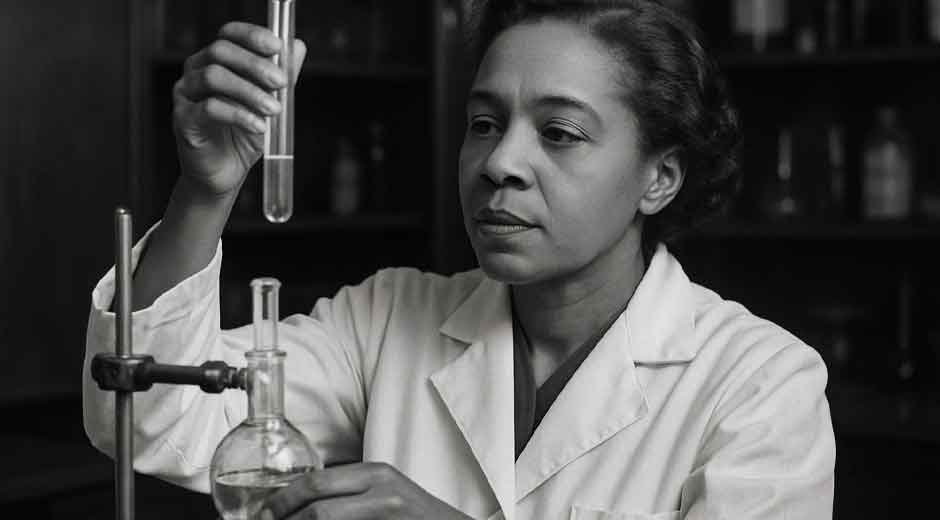
Introduction: Who Was Marie Maynard Daly?
Did you know that the first African American woman to earn a Ph.D. in chemistry in the United States was a brilliant biochemist whose work laid the foundation for understanding heart disease? That woman was Marie Maynard Daly.
Her life story is a powerful testament to the triumph of intellect and perseverance over the dual challenges of racial and gender discrimination in 20th-century science.
Born in Queens, New York, in 1921, Daly was raised in a family that deeply valued education. Her father, a postal clerk who had to abandon his own chemistry studies at Cornell due to financial constraints, was a profound source of inspiration. Her mother, Helen, fostered a love for reading and science, particularly through books like Paul De Kruif’s *Microbe Hunters*.
This early encouragement set her on an accelerated academic path that would quickly lead her to break one of the most significant barriers in American science.
An Accelerated Path to a Historic Ph.D.
Daly’s academic journey was marked by speed and excellence. She attended Hunter College High School, an institution that admitted students based on merit, where she found supportive female role models who encouraged her scientific ambitions.
She then attended Queens College, graduating with honors in chemistry in 1942. With the world at war, many men had left their positions, creating temporary openings for women and minorities in science—a window of opportunity Daly seized.
She completed her Master’s degree at New York University in a single year. By 1944, she was a doctoral student at Columbia University, where she studied under Dr. Mary L. Caldwell, a pioneering woman in chemistry.
In 1947, at the age of 26, Marie Maynard Daly earned her Ph.D. in chemistry, making her the first African American woman in the nation to achieve this distinction. Her dissertation focused on the products formed by the action of pancreatic amylase on corn starch.
Groundbreaking Research in Molecular Biology
Following her historic graduation, Daly secured a grant from the American Cancer Society, which allowed her to join the Rockefeller Institute of Medicine. This seven-year period was highly productive, focusing on the intricate structure of the human body.
Her early work was instrumental in the field of molecular biology. She investigated the composition and function of **histones**, which are proteins that bind to DNA and help dictate the structure of chromosomes.
She also conducted research on the proportions of nucleotides, the building blocks of DNA and RNA, and explored the role of RNA in protein synthesis. This foundational work was a crucial precursor to the later identification of the DNA double helix structure.
Unlocking the Secrets of the Heart
Perhaps Daly’s most widely recognized contribution came later in her career, in collaboration with Dr. Quentin B. Deming at Columbia University and later at the Albert Einstein College of Medicine. Their research shifted focus to the causes of heart attacks.
Their groundbreaking studies, often conducted on rats, revealed a critical link between high levels of **cholesterol** and blocked arteries, as well as the connection to hypertension. This work was pivotal in establishing a new understanding of how diet and lifestyle affect the health of the heart and circulatory system.
It provided a scientific basis for the dietary recommendations that are now commonplace in the prevention of cardiovascular disease.
A Legacy of Mentorship and Advocacy
Daly’s impact extended far beyond the laboratory bench. After becoming an associate professor at Albert Einstein College of Medicine in 1971, she dedicated herself to increasing minority representation in science.
Recognizing the systemic barriers she herself had overcome, she actively advised graduate students and developed programs to encourage minority enrollment in STEM fields. She even issued national recommendations for the professional advancement of minority women scientists.
In 1988, she established the Ivan C. and Helen H. Daly Scholarship at Queens College in honor of her parents. This scholarship continues to support students of color in the physical sciences, ensuring her legacy of breaking barriers and lifting others endures.
Conclusion: A Pioneer’s Enduring Impact
Marie Maynard Daly passed away in 2003, but her contributions to biochemistry and her pioneering role as a woman of color in science remain indelible. Her work on histones, protein synthesis, and the link between cholesterol and heart disease continues to inform medical science today.
More than just a scientist, she was a dedicated educator and advocate who used her position to pave the way for future generations, proving that the most profound discoveries often come from those who have to fight the hardest to be heard.
Frequently Asked Questions (FAQ)
What was Marie Maynard Daly’s major contribution to science?
Her most significant contributions were in two main areas: first, her foundational work on the structure and function of **histones** and the role of RNA in protein synthesis, which was crucial to the field of molecular biology; and second, her later research that established a clear link between high cholesterol, hypertension, and clogged arteries, which greatly advanced the understanding of cardiovascular disease.
Why is Marie Maynard Daly considered a pioneer?
She is considered a pioneer because she was the first African American woman in the United States to earn a Ph.D. in chemistry, which she achieved from Columbia University in 1947. This accomplishment broke a significant racial and gender barrier in the scientific community.
Where did Marie Maynard Daly work?
Dr. Daly held research and teaching positions at several prestigious institutions. These included Howard University, the Rockefeller Institute of Medicine, Columbia University, and the Albert Einstein College of Medicine at Yeshiva University, where she eventually became an associate professor.

- I’m Aliza, the founder of Urdu Novel Bank. I built this site because I love Urdu stories and want everyone to enjoy them. As an Urdu literature lover, I choose the best novels to share with you. Here you can find free Urdu novels in romance, mystery, thriller and more. Read online or download PDF chapters without signing up. I update the library often so you’ll always have new tales to explore. My goal is to bring Urdu literature to readers around the world.
Latest Novels
- July 29, 2026Home ImprovementCabinet Painting Cost Per Linear Foot: Complete Pricing Guide for Kitchens
- May 4, 2026Urdu Romantic NovelsHow Incorporating Moroccan Tile Enhances Your Home Décor
- April 29, 2026Home ImprovementHow Finding a Reliable Plumber Near Me Transforms Plumbing Emergencies
- April 27, 2026Home ImprovementHow to Plan a Layered Lighting Scheme for Your Bedroom Renovation