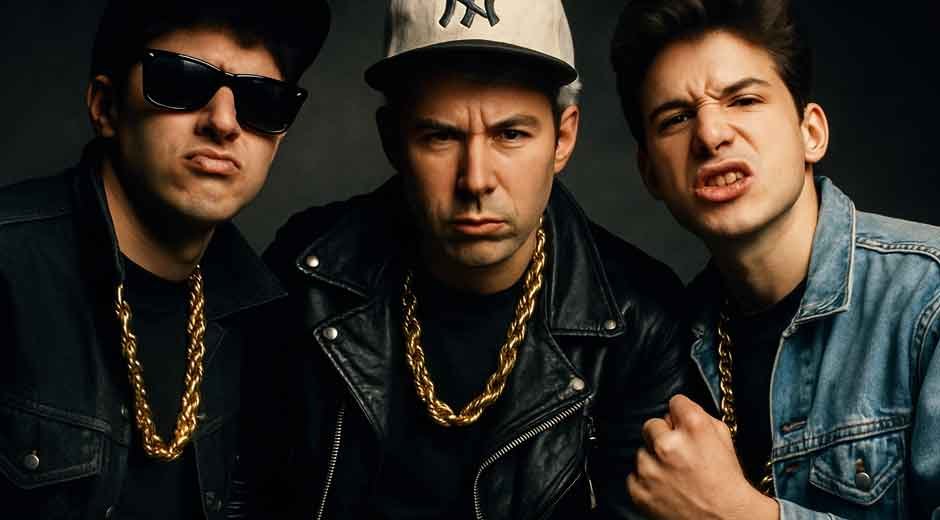
I. Introduction: The Moment Hip-Hop Went Platinum
Can a single album truly change the trajectory of a genre, simultaneously launching a global phenomenon while sowing the seeds of its own controversy? That is the complex, enduring question surrounding the Beastie Boys’ debut, Licensed to Ill. Released in 1986, this record was not just a collection of songs; it was a cultural flashpoint, a defiant, beer-soaked roar that smashed through the established boundaries of music. It achieved a feat previously unheard of: becoming the first rap album to ever top the Billboard 200 chart.
The album’s immediate, unprecedented success signaled a seismic shift in the music landscape. It took the raw, street-level energy of hip-hop and injected it with a massive dose of rock-and-roll swagger.
This made it palatable—and irresistible—to a vast, predominantly white, mainstream audience. The sheer audacity and infectious energy of the record ensured that the Beastie Boys were no longer just a novelty act; they were a force of nature.
II. From Punk Rock to Def Jam
To understand the sound of Licensed to Ill, one must first look back at the Beastie Boys’ origins. Michael “Mike D” Diamond, Adam “MCA” Yauch, and Adam “Ad-Rock” Horovitz initially formed in the early 1980s as a hardcore punk band. This punk rock foundation is crucial, as it instilled in them a sense of irreverence, noise, and anti-establishment attitude that would define their later work.
Their transition to hip-hop was not a clean break but a gradual, experimental evolution. The pivotal moment came with their partnership with producer Rick Rubin and his label, Def Jam Records. Rubin, a co-founder of the label, recognized the potential in their blend of rock aggression and rap delivery. He helped them harness their chaotic energy into a commercially viable, yet still rebellious, sound.
III. A Groundbreaking Fusion of Sound
The sonic blueprint of Licensed to Ill is a masterpiece of early sampling and genre fusion. The album is characterized by its aggressive, hard-hitting beats, often layered with heavy metal guitar riffs and classic rock samples. This combination was revolutionary, effectively creating a new subgenre of party-rock hip-hop.
Rubin’s production is raw and thunderous, giving the tracks a massive, arena-ready sound. The trio’s vocal delivery—loud, arrogant, and endlessly quotable—perfectly matched the music’s abrasive energy.
They weren’t trying to be traditional rappers; they were three young men from New York licensed to be ill, creating a sound that was both a tribute to and a mockery of rock and rap conventions.
IV. The Anthems of a Generation
The album is packed with tracks that became instant cultural anthems, defining the sound of late 80s youth culture. The most famous, of course, is “Fight For Your Right (To Party!),” a track that became a rallying cry for youthful rebellion and excess, despite the band later claiming it was intended as a parody of the very attitude it celebrated.
Other standout tracks, such as the Led Zeppelin-sampling “No Sleep Till Brooklyn” and the instantly recognizable “Brass Monkey,” further cemented the album’s status. These songs, with their themes of drinking, partying, and general mischief, resonated deeply with a generation looking for a soundtrack to their own youthful defiance.
V. The Cultural Juggernaut and Commercial Success
Licensed to Ill was a commercial leviathan. It has sold over 10 million copies in the United States alone, earning the rare Diamond certification.
This massive success was not just a win for the Beastie Boys; it was a watershed moment for hip-hop, proving its mainstream viability and commercial power beyond any doubt.
The album successfully crossed the cultural divide, introducing hip-hop to audiences who might never have listened to it otherwise.
It was a Trojan horse, using the familiar sounds of rock to smuggle a new genre into the homes and stereos of millions, forever changing the demographics of the hip-hop audience.
VI. Reckoning with the Controversy
Despite its groundbreaking success, Licensed to Ill is an album that cannot be discussed without addressing its controversial elements. The lyrical content is often juvenile, featuring themes of misogyny, female degradation, and an uncritical celebration of excess. The band’s stage show at the time, which included a giant hydraulic penis and women dancing in cages, only amplified these criticisms.
In the years that followed, the Beastie Boys matured significantly, both personally and musically. They publicly expressed regret and distance from the more offensive aspects of their debut, particularly the misogynistic lyrics. This later evolution, marked by albums like Paul’s Boutique and Check Your Head, provides a necessary context for understanding Licensed to Ill as a product of youthful immaturity and a specific moment in time.
VII. The Enduring Influence
Decades later, the influence of Licensed to Ill remains undeniable. It is a foundational text for the rap-rock genre, inspiring countless artists who sought to blend the power of guitar music with the rhythm of hip-hop. More importantly, it established the Beastie Boys as one of the most innovative and enduring groups in music history.
The album’s legacy is complex: a masterpiece of production and energy, yet a problematic artifact of its era.
It stands as a testament to the power of artistic rebellion and the moment when three former punk rockers, licensed to ill, irrevocably changed the sound of popular music.
VIII. Frequently Asked Questions (FAQ)
What does “Licensed to Ill” mean?
The phrase “Licensed to Ill” is a play on the James Bond movie title Licensed to Kill. It perfectly encapsulates the album’s rebellious, arrogant, and “bad boy” attitude. It suggests that the Beastie Boys had official permission, or a “license,” to be wild, outrageous, and musically disruptive.
How many copies did “Licensed to Ill” sell?
Licensed to Ill has sold over 10 million copies in the United States, achieving Diamond certification from the Recording Industry Association of America (RIAA). This makes it one of the best-selling hip-hop albums of all time.
Who produced “Licensed to Ill”?
The album was produced by the legendary Rick Rubin. His work on Licensed to Ill is considered a landmark achievement in music production, defining the sound of early Def Jam and pioneering the fusion of rock and hip-hop.

- I’m Aliza, the founder of Urdu Novel Bank. I built this site because I love Urdu stories and want everyone to enjoy them. As an Urdu literature lover, I choose the best novels to share with you. Here you can find free Urdu novels in romance, mystery, thriller and more. Read online or download PDF chapters without signing up. I update the library often so you’ll always have new tales to explore. My goal is to bring Urdu literature to readers around the world.
Latest Novels
- July 29, 2026Home ImprovementCabinet Painting Cost Per Linear Foot: Complete Pricing Guide for Kitchens
- May 4, 2026Urdu Romantic NovelsHow Incorporating Moroccan Tile Enhances Your Home Décor
- April 29, 2026Home ImprovementHow Finding a Reliable Plumber Near Me Transforms Plumbing Emergencies
- April 27, 2026Home ImprovementHow to Plan a Layered Lighting Scheme for Your Bedroom Renovation