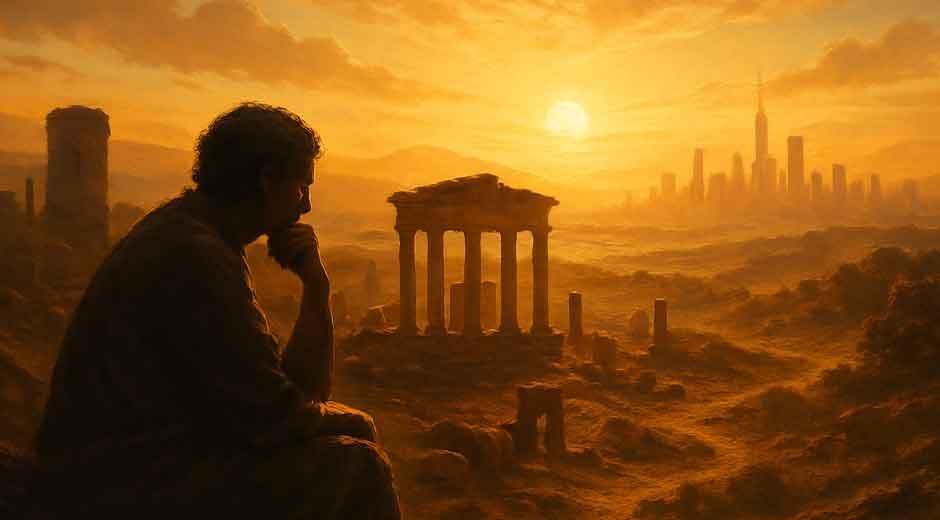
What if the story we tell ourselves about human history—the one about a slow, inevitable march from simple, egalitarian hunter-gatherers to complex, hierarchical states—is fundamentally wrong? This is the provocative question at the heart of The Dawn of Everything: A New History of Humanity.
Written by the late anthropologist David Graeber and archaeologist David Wengrow, this monumental work dismantles centuries of conventional wisdom. It suggests that our ancestors were not passive players in a historical drama, but active, conscious architects of their own diverse societies.
The book is less a definitive history and more a powerful, evidence-based argument for reclaiming the sheer possibility of human social organization. It challenges us to look beyond the rigid narratives we have inherited.
The Myth of the “Civilization Trap”
For generations, thinkers have been trapped by a simple, linear narrative. This story posits that the invention of agriculture was a “trap,” an irreversible step that led directly to private property, social stratification, and the eventual loss of freedom.
Graeber and Wengrow reject this idea outright. They argue that the transition to farming was a slow, uneven process that took millennia, and was often consciously abandoned by groups who found it undesirable.
Crucially, they show that many large-scale societies existed without the centralized, top-down control we assume is necessary. Human social structures were far more flexible and experimental than the standard history allows.
The Indigenous Critique: A Mirror to European Society
One of the book’s most compelling arguments is that the Enlightenment’s focus on “freedom” and “equality” was not an internal European invention. Instead, it was profoundly shaped by the sophisticated critiques leveled by Indigenous North American thinkers.
Figures like the Wendat leader Kondiaronk, whose dialogues were recorded by European travelers, offered a powerful counter-model to European society. He criticized its obsession with wealth, its lack of personal freedom, and its punitive legal systems.
The authors suggest that the very idea of a linear, evolutionary history—the one the book seeks to overturn—was developed partly as a way to dismiss this Indigenous critique as merely the naive ramblings of “primitive” people.
The Freedom to Switch: Seasonal Social Structures
Archaeological evidence reveals a stunning degree of social fluidity in the past. Rather than being locked into a single system, many ancient societies practiced what the authors call “seasonal political regimes.”
A community might live under a highly authoritarian, hierarchical structure during one part of the year, perhaps for a large-scale seasonal hunt or festival. Yet, for the rest of the year, the same people would revert to a decentralized, communal, and egalitarian mode of life.
This ability to consciously and deliberately switch social forms demonstrates that hierarchy was often a temporary choice, not an inevitable destination. They were masters of their own political destiny.
Cities Without Kings: Egalitarian Urban Life
The existence of large cities is often taken as proof of a powerful, centralized state. However, the book presents cases of massive urban centers that defy this expectation.
Sites like Teotihuacan in Mexico, or the ancient city of Çatalhöyük in Turkey, show little to no evidence of the expected trappings of centralized power: no grand palaces, no central storage facilities, and no obvious signs of a ruling elite.
In some cases, like the Indigenous city of Tlaxcala, democratic institutions and popular assemblies were a defining feature of urban life long before the arrival of Europeans. These were cities built on cooperation, not command.
Power, Not Progress: The Three Sources of Domination
To move beyond the concept of “the State,” the authors propose a new framework for understanding domination. They identify three distinct sources of power that can combine in various ways.
These are: control over violence (sovereignty), control over information (bureaucracy), and charismatic competition (politics). Modern states combine all three, but many ancient societies only employed one or two.
By separating these elements, the book shows that the modern state is not the natural endpoint of human progress. Instead, it is a specific, historically contingent configuration that emerged from a complex series of choices and accidents.
Conclusion: Reclaiming Human Possibility
The Dawn of Everything is ultimately a hopeful book. By demonstrating that our ancestors experimented with countless ways of living—from radical freedom to temporary hierarchy—it suggests that our current social and political arrangements are not fixed.
The book provides a powerful intellectual toolkit for imagining a different future. It reminds us that if humans have created diverse, complex, and free societies in the past, we can certainly do so again.
Frequently Asked Questions About The Dawn of Everything
Who are the authors of The Dawn of Everything?
The book was co-authored by the late anthropologist David Graeber and the archaeologist David Wengrow. Graeber was a prominent figure in the Occupy movement, and Wengrow is a professor of comparative archaeology at University College London.
What is the main argument of The Dawn of Everything?
The central argument is that human societies throughout history were far more diverse, complex, and flexible than the standard narrative suggests. It challenges the idea of a linear progression from simple, egalitarian hunter-gatherers to complex, hierarchical states, arguing that our ancestors consciously chose their social forms.
Is The Dawn of Everything historically accurate?
The book is based on extensive archaeological and anthropological evidence, synthesizing decades of research. While it has been widely praised for its synthesis of data, it has also generated significant academic debate and criticism regarding its interpretations and methodology, particularly from historians and other anthropologists.

- I’m Aliza, the founder of Urdu Novel Bank. I built this site because I love Urdu stories and want everyone to enjoy them. As an Urdu literature lover, I choose the best novels to share with you. Here you can find free Urdu novels in romance, mystery, thriller and more. Read online or download PDF chapters without signing up. I update the library often so you’ll always have new tales to explore. My goal is to bring Urdu literature to readers around the world.
Latest Novels
- July 29, 2026Home ImprovementCabinet Painting Cost Per Linear Foot: Complete Pricing Guide for Kitchens
- May 4, 2026Urdu Romantic NovelsHow Incorporating Moroccan Tile Enhances Your Home Décor
- April 29, 2026Home ImprovementHow Finding a Reliable Plumber Near Me Transforms Plumbing Emergencies
- April 27, 2026Home ImprovementHow to Plan a Layered Lighting Scheme for Your Bedroom Renovation